GTM Agency vs In-House GTM Team: Which Is Better for B2B Growth in 2026 and 2027?
Last updated: 25 October 2026
Last updated: 25 October 2026
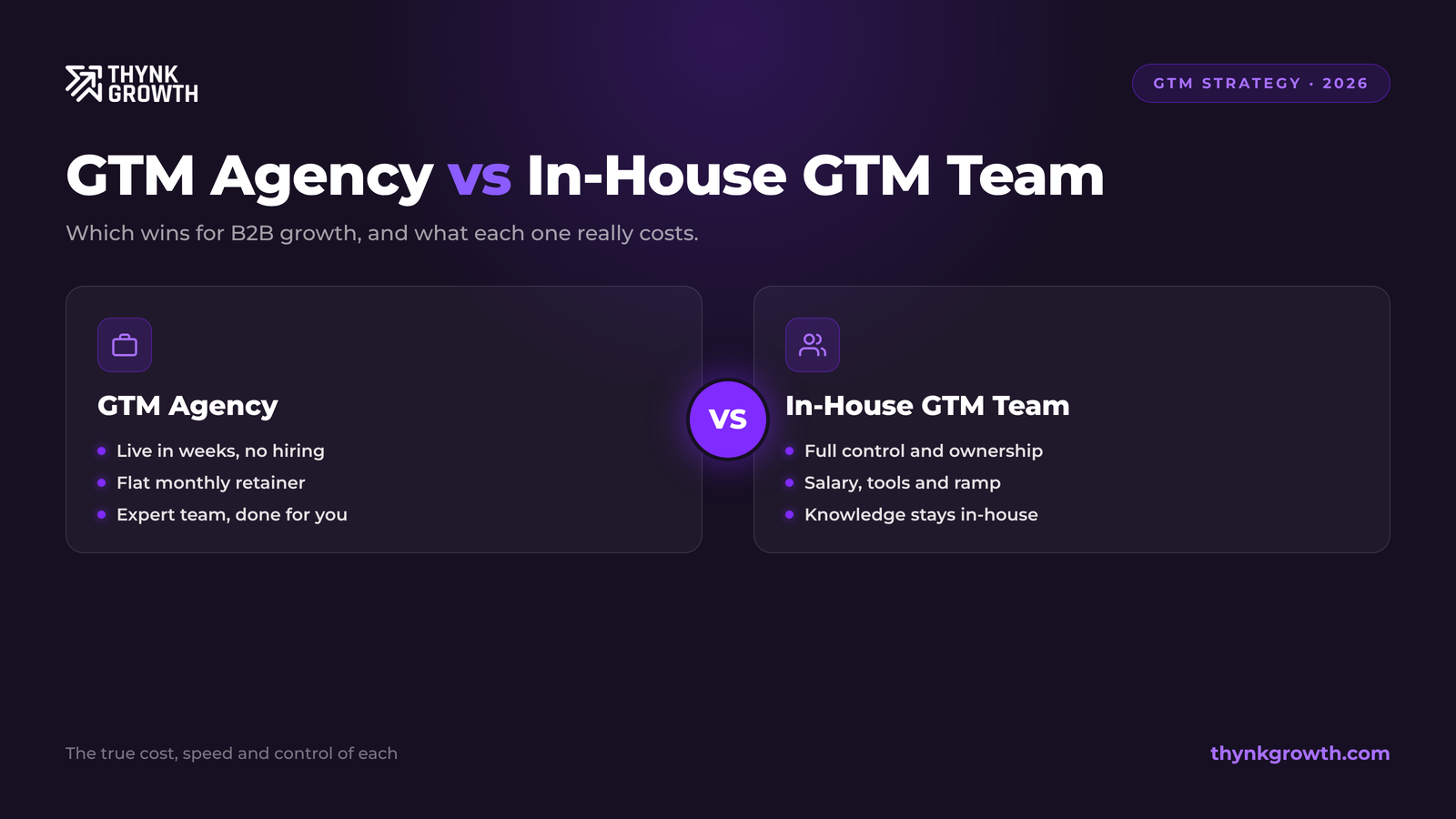
A GTM agency gives you a built, running outbound system in weeks, on a monthly retainer, with no hiring or ramp. An in-house GTM team gives you control, owned process and dedicated focus, but you pay salaries, tools and months of ramp before it produces. For most B2B companies in 2026 and 2027, an agency wins on speed and cost per meeting early on, while an in-house team wins once outbound is core to the business and the volume justifies full-time headcount. The honest answer is that many teams do both, in that order.
ThynkGrowth sits on both sides of this question, so this is first-hand rather than one-sided. We are a signal-led B2B outbound agency and a Clay Solutions Partner that runs done-for-you outbound for clients, and we also train in-house operators through our coaching cohort. Faraz Ahmed, founder of ThynkGrowth, built and ran a $6.12M quarterly ABM pipeline engine as the sole Clay operator at an enterprise SaaS company, trained 70 BDRs on AI and Clay, and holds all four Clay certifications. We make money either way, so we have tried to keep this fair.
What is a GTM agency vs an in-house GTM team?
A GTM agency is an outside team that builds and runs your go-to-market motion for you: targeting, data, outbound infrastructure, copy and campaigns, usually on a monthly retainer. An in-house GTM team is people you employ to do the same work, typically a GTM engineer plus SDRs or a growth hire, using tools you buy and own.
The difference is not just who sends the emails. It is who owns the system, who carries the risk, and who improves it over time. An agency brings a finished playbook and runs many accounts, so it learns fast. An in-house team knows your product and market deeply, and every improvement stays with you. For a fuller definition of the agency model, see our explainer on what a GTM agency is.
How do the costs really compare?
Comparing a monthly retainer to one salary is the mistake that sinks most of these decisions. The real in-house cost is the salary plus tools, data, mailboxes, management time, and three to six months of ramp before anything works. The real agency cost is the retainer, which usually bundles the system and the expertise and starts producing in weeks.
Here is the fuller picture, in ranges rather than quotes, because both vary with scope.
| Cost factor | GTM agency | In-house GTM team |
|---|---|---|
| Headline cost | Monthly retainer, roughly $1,500 to $3,000 a month for early-stage outbound | Salary: an SDR runs roughly $60,000 to $90,000 fully loaded; a GTM engineer more |
| Tools, data, mailboxes | Often bundled or set up for you | You buy and manage them on top of salary |
| Time to first output | Weeks | Three to six months of hiring and ramp |
| Management overhead | The agency manages the work | You manage, coach and review |
| Risk of a bad fit | Switch or pause the retainer | A mis-hire costs months and the salary |
The point is not that one is always cheaper. It is that the in-house number on a spreadsheet is almost always understated, because the ramp, the tools and the management do not show up next to the salary. If you are weighing a first hire specifically, our guide on GTM coaching vs hiring an SDR at an early-stage company goes deeper.
Which is faster to pipeline?
An agency is almost always faster to first meetings, because it arrives with infrastructure, a playbook and operators who have done it before. An in-house hire has to be sourced, onboarded, given tools, and allowed to ramp before the first campaign is sound. Speed is the agency's clearest advantage.
The gap is widest at the start. A capable agency can have domains warming, data flowing and a first campaign live while you would still be interviewing. Over a longer horizon the gap narrows, because an in-house team that has ramped knows your market intimately. If speed to pipeline this quarter is the priority, that favours the agency. If you are building a motion to run for years, the ramp is an investment rather than a delay.
Which gives you more control and owned process?
An in-house team wins on control and ownership. The workflows, the data and the lessons stay inside your company, and the team can turn on a sixpence when positioning or ICP changes. An agency gives you speed and expertise, but the system lives partly with them, so you have less direct control and a dependency to manage.
This is the real trade behind the cost question. With an agency you rent a result; with a team you build a capability. Neither is wrong, but they suit different stages. If outbound is becoming core to how you grow, owning it matters more. A sensible middle path is to have an agency run the engine now and build it in a way you can bring in-house later, with documentation and a clean handover, so the knowledge transfers instead of walking out the door. A good agency should be happy to work that way.
What are the risks of each?
The main agency risks are dependency and divided attention: the system sits partly outside your walls, and you are one of several clients. The main in-house risks are a mis-hire and a long ramp: one wrong hire costs months and a salary, and even a good hire produces nothing while learning.
You can manage the agency risk by asking, up front, what you receive at the end: documentation, workflows and access to the data, so you are not stranded if you part ways. You can lower the in-house risk by training rather than gambling on a unicorn hire, and by giving the new person a proven system to run instead of a blank page. For what that system looks like once built, read how to build a signal-led GTM system in 2026.
Which should you choose for B2B growth?
Choose an agency when you need pipeline soon, outbound is not yet core, and nobody internal can build it. Choose in-house when outbound is central to growth, volume justifies full-time headcount, and you want to own the capability. Many companies do both: an agency to start producing now, then an in-house owner trained to take it over.
- Pre-product-market-fit or testing outbound: an agency, because you want signal fast without a permanent cost.
- Clear offer, need meetings this quarter, no builder on staff: an agency is the fastest route to pipeline.
- Outbound is a core channel and you are scaling it: build in-house, and bring in a proven system rather than starting from zero.
- You want both speed now and ownership later: run the agency engine while you train your operator, then hand it over.
If you want the engine run for you, that is exactly what ThynkGrowth does: our done-for-you outbound service builds and runs a signal-led outbound system so you get pipeline without hiring, and hands over documentation if you later bring it in-house. Either way, the worst option is a rushed hire with no system and no support, because that is where the salary, the ramp and the risk all land at once. For the hiring side specifically, see how to hire a GTM engineer.
Is a GTM agency better than an in-house team?
Neither is universally better. An agency is better for speed and early-stage cost per meeting, because it arrives with infrastructure and expertise. An in-house team is better once outbound is core and you want to own the process, data and lessons.
How much does a GTM agency cost compared to hiring in-house?
Early-stage outbound agencies typically charge a monthly retainer in the low thousands, often bundling tools and setup. Hiring in-house means a salary plus tools, data and three to six months of ramp, so the true in-house cost is usually higher than the salary alone suggests.
When should you build an in-house GTM team?
Build in-house when outbound is a core growth channel, the volume justifies full-time headcount, and you want to own the capability rather than rent it. It is usually the right move after you have proven the motion works, often with an agency first.
Can you use a GTM agency and an in-house team together?
Yes, and it is a common and sensible path. An agency produces pipeline now while you hire or train an internal owner, then you transfer the system in-house. Ask the agency for documentation and a handover so the transition is clean.
Will a GTM agency still make sense in 2027?
Yes. As outbound gets more technical, with signals, enrichment and AI layered in, the bar to run it well keeps rising, so the case for an expert agency early on holds into 2027. What changes is that more teams bring the capability in-house once it is core, usually by training an operator rather than gambling on a single unicorn hire.
Want this running for your pipeline?
Book a free strategy call. We map your outbound plan whether you work with us or not.
Book a free strategy call