Clay vs Apollo: Which Should You Use in 2026?
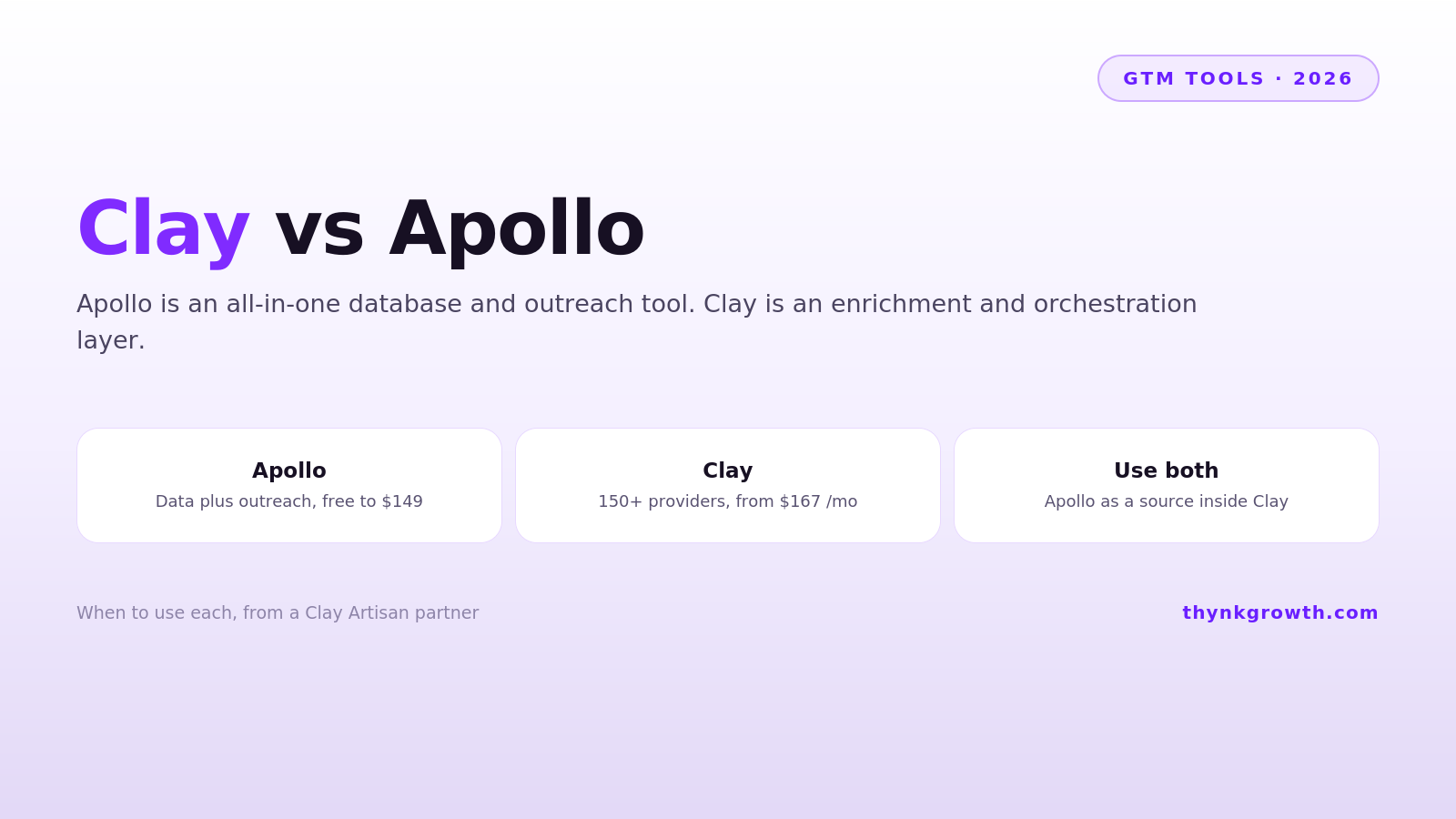
Clay and Apollo get compared constantly, but they are not the same category of tool. Apollo is an all-in-one B2B database with outreach built on top: you search its own data, then sequence and dial from the same place, starting free and running from 59 to 149 dollars per user a month. Clay is an enrichment and orchestration layer: it does not own one database, it pulls from 150 plus providers with waterfall logic and AI research, starting at 167 dollars a month plus credits. Use Apollo when you want data and outreach in one affordable tool. Use Clay when you are building custom enrichment workflows and want the best coverage from many sources. Many teams actually use both, with Apollo as one data source inside Clay.
I hold all four Clay certifications as a Clay Artisan Solutions Partner and I operated Clay daily at an enterprise procuretech SaaS company, and I also run Apollo across client accounts. So this is not a loyalty pitch for either. They solve different jobs.
What Apollo is best at
Apollo's strength is simplicity and value. One tool gives you a large contact and company database, email and sequence tools, and a dialer, from a free plan up through Organization at 149 dollars per user a month. For a founder or a small sales team that wants to find people and email them without wiring together a stack, Apollo is the fastest path and the lowest entry cost. The tradeoff is that you are limited to Apollo's own data quality, which is strong in North America and thinner in some regions, and its native sending is fine for light volume but not built for heavy, deliverability-sensitive cold email.
What Clay is best at
Clay's strength is coverage and flexibility. Because it runs waterfall enrichment across many providers, it finds and verifies data that any single database, including Apollo, will miss, and its Claygent AI research can pull custom attributes that no static database stores. This is why GTM engineers live in Clay: it is programmable. The tradeoff is cost and skill. Clay charges data credits and action credits, so heavy workflows add up, and it rewards someone who knows how to build in it. Used well, it is the most capable data tool in the category.
How to choose
Pick Apollo if you want one affordable tool for data and outreach and your targeting is mostly North American. Pick Clay if you need maximum data coverage, custom enrichment, or AI research, and you have someone to operate it. And do not overlook the combined play: use Apollo as a low-cost data source inside a Clay waterfall, so Clay only spends premium credits when Apollo comes up empty. That is often the most cost-effective setup of all.
The honest tradeoff
Apollo can feel cheaper until you scale seats and hit credit limits, and Clay can feel expensive until you count the multiple point tools it replaces. Neither is a sending platform for serious cold email, so pair either with a dedicated tool like Smartlead or Instantly and real domain infrastructure. If you would rather have the data and enrichment layer designed and run for you, that is part of the GTM infrastructure we build at ThynkGrowth.
What is the difference between Clay and Apollo?
Apollo is an all-in-one B2B database with built-in outreach and dialer, using its own data. Clay is an enrichment and orchestration layer that pulls from 150 plus data providers with waterfall logic and AI research, and does not own a single database. Apollo is a product you search; Clay is a system you build.
Is Clay better than Apollo?
Neither is universally better. Clay is more powerful and flexible for custom enrichment and data coverage but costs more and needs an operator. Apollo is simpler, cheaper to start, and combines data with outreach, but is limited to its own data quality. It depends on your use case.
Should I use Clay or Apollo for prospecting?
Use Apollo if you want fast, affordable data plus outreach in one tool, especially for North American targeting. Use Clay if you need broader coverage, custom data points, or AI research and have someone to operate it. Many teams use Apollo as a data source inside Clay.
Can Clay and Apollo work together?
Yes, and it is a common setup. You can plug Apollo into Clay as one of many enrichment sources, so Clay uses Apollo's data first and only spends premium credits on other providers when Apollo has no match. This lowers cost while keeping coverage high. ---
Related reading
Want this running for your pipeline?
Book a free strategy call. We map your outbound plan whether you work with us or not.
Book a free strategy call